


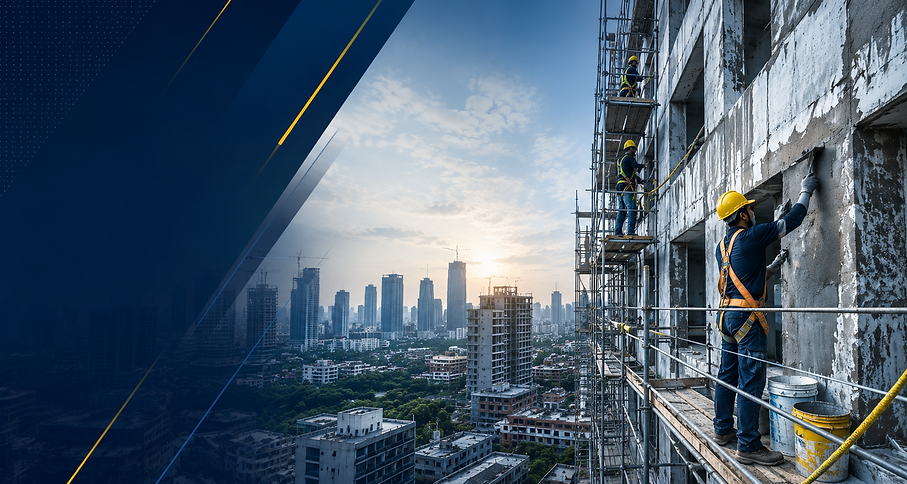
ENGINEERING REFURBISHMENTS & STRUCTURAL REPAIRS
Book a free site visit and find the best quote. Call now!
Engineering Stronger Structures for Tomorrow.
Every structure ages — but how well it ages depends on how well it's maintained. Concrete spalling, rebar corrosion, cracking, and general wear can quietly compromise a building's safety and value long before the damage is visible from a distance. Our refurbishment services focus on restoring structural integrity and extending a property's useful life, starting with a proper understanding of the damage rather than a surface- level patch-up.
Signs Your Building May Need Refurbishment
-
Visible cracks in beams, columns, or slabs
-
Spalling (flaking or crumbling) concrete, especially with exposed reinforcement
-
Rust stains bleeding through paint or plaster
-
Sagging or visibly deflected slabs and beams
-
Persistent dampness that hasn't been addressed
-
A building's age combined with a lack of recent maintenance
-
Widening cracks at joints or visible movement in the structure
Our Services
Concrete Repair & Restoration Spalled, cracked, or deteriorated concrete needs more than a cosmetic patch — the repair method has to match the type and depth of damage. We use polymer-modified repair mortars and restoration techniques suited to the specific condition of the concrete.
Rebar Corrosion Treatment Corrosion is one of the leading causes of structural damage, and it's a self-accelerating problem — rusted steel expands and cracks the concrete around it, which lets in more moisture and speeds up further corrosion. We break this cycle by treating exposed and corroded reinforcement directly, then protecting it against future corrosion.
Structural Strengthening, Jacketing & Retrofitting Where a structure needs additional load-bearing capacity — due to design changes, added floors, or updated safety codes — we strengthen columns, beams, and slabs using techniques like RCC or steel jacketing and FRP (fibre-reinforced polymer) wrapping, chosen based on the space and loading requirements.
Epoxy & Polyurethane Grouting For cracks that go beyond surface-level, we use epoxy and PU-based injection grouting to fill voids and restore structural continuity — bonding the crack from within rather than just sealing it on the surface.
Guniting & Shotcrete Repair For larger-scale concrete repair — such as extensive spalling across a wall or slab — we use guniting (sprayed concrete/mortar) to rebuild the surface efficiently while maintaining structural bond strength.
Chemical Anchoring & Dowelling When new structural elements, railings, or fixtures need to be securely fixed into existing concrete, we use chemical anchoring systems that provide reliable, high-strength fixing without weakening the host structure.
Expansion & Construction Joint Repairs Joints that have deteriorated or failed over time allow water and movement-related stress into the structure. We restore these joints to prevent further damage and maintain the structure's ability to move safely.
Protective & Decorative Coatings Once repairs are complete, protective coatings guard concrete and masonry surfaces against carbonation, chloride attack, and general weathering — extending the life of the repair itself
Materials & Techniques We Use
Our repair work draws on industry-standard systems, matched to the type and severity of damage:
-
Polymer-modified repair mortars — for structural and cosmetic concrete repair
-
Anti-corrosive rebar coatings — to halt existing corrosion and prevent recurrence
-
Epoxy & PU injection resins — for crack sealing and structural bonding
-
FRP (fibre-reinforced polymer) wraps — for strengthening without adding significant weight
-
Micro-concrete & shotcrete — for larger-scale structural restoration
Our Process
1. Structural assessment — a visual inspection and, where needed, further testing to understand the extent and cause of damage
2. Repair methodology & reporting — a clear scope of work explaining what needs to be done, and why
3. Execution by trained crews — skilled application of repair systems, following recommended procedures and curing times
4. Quality checks — verification at each stage to confirm the repair is performing as intended
5. Documentation & handover — a record of the work carried out, useful for future maintenance planning