


OUR PROJECTS
Delivering reliable, durable and innovative solutions across infrastructure and industrial sectors.
PROJECTS EXECUTED - DEV ENTERPRISES
PROJECT
01
Why This Matters
CTP 11 – Precast Grouting (JNPT to Virar Corridor)
Maharashtra
Infrastructure
Completed
📋 Scope of Work
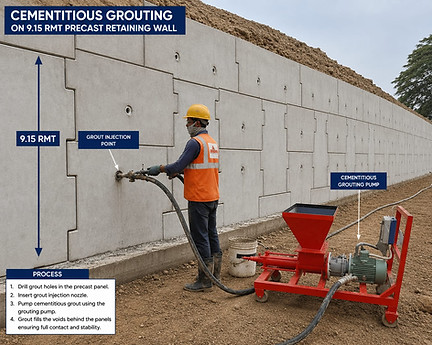
Grouting of precast segments at varying heights (4m, 8m, and 9.15 rmt) across the entire stretch from JNPT to Virar. This involved filling the gap between precast elements and the supporting structure (bearings/pedestals) with a high-strength, non-shrink cementitious or epoxy grout to ensure uniform load transfer.
Precast construction is widely used in large infrastructure corridors because it speeds up construction — but the precast segments must be perfectly bedded onto their supports for the structure to behave as designed. Any gap or void beneath a precast unit means the load is not evenly distributed, creating stress concentrations that can lead to cracking, spalling, or even premature failure of the precast element. Precast grouting fills these voids completely, ensures uniform bearing, prevents water accumulation at the joint (which would otherwise cause corrosion of embedded reinforcement), and is critical for the long-term stability and safety of an infrastructure stretch spanning such a large corridor

PROJECT
02
Mumbai Trans Harbour Link (Atal Setu) – Jacketing, Injection Grouting, Bearing Grouting
Maharashtra
Infrastructure
Completed
📋 Scope of Work
-
Jacketing – Strengthening/protecting structural members exposed to the harsh marine environment.
-
Injection Grouting– Sealing cracks and voids within concrete elements to prevent chloride/water ingress.
-
Bearing Grouting – Filling the gap between bridge bearings and the pier/pile cap to ensure uniform load transfer from the superstructure to the substructure.
Why This Matters
A sea-bridge structure faces one of the most aggressive environments in civil engineering — constant exposure to saline water, humidity, and chloride attack, all of which accelerate reinforcement corrosion. Jacketing protects vulnerable structural members from this marine exposure. Bearing grouting is especially critical: bridge bearings transfer massive dynamic loads (traffic + seismic + wind), and any gap beneath a bearing can cause uneven stress distribution, leading to bearing damage or structural distress over time. Given that Atal Setu is a landmark, high-traffic national infrastructure asset, these works are vital to ensuring decades of safe, maintenance-efficient service life.

PROJECT
03
Why This Matters
Shree Dhootpapeshwar Limited – Factory, Rasayni – PU Flooring
Rasayni Maharashtra
Industrial
Completed
📋 Scope of Work
Application of Polyurethane (PU) flooring system across the manufacturing facility — a seamless, high-build resin flooring system applied over prepared concrete substrate.
Pharmaceutical and manufacturing facilities require flooring that can withstand heavy machinery movement, chemical spillage, thermal shock, and constant foot/vehicular traffic — while also meeting strict hygiene standards. PU flooring is chosen because it is:
-
Chemical & abrasion resistant – withstands exposure to acids, alkalis, solvents, and oils common in pharma/manufacturing environments.
-
Seamless & hygienic – no joints or crevices where bacteria, dust, or contaminants can accumulate, critical for GMP-compliant facilities.
-
Thermal shock resistant– performs well in areas with hot water washdowns or steam cleaning.
-
Durable – reduces long-term maintenance costs compared to conventional flooring like tiles or plain concrete.
Without a proper industrial flooring system, factory floors deteriorate rapidly under chemical attack, leading to dusting, cracking, and hygiene failures — directly impacting production quality and safety compliance.

PROJECT
04
Why This Matters
Welspun One – Expansion Joint Waterproofing
Maharashtra
Industrial
Completed
📋 Scope of Work
Waterproofing treatment applied specifically at expansion joints — the designed gaps between structural sections that allow for movement due to thermal expansion, contraction, and seismic activity.
Expansion joints are, by design, the weakest point in a structure's waterproofing envelope since they must remain flexible rather than rigid. If not properly waterproofed, they become the primary entry point for water into the building structure — leading to corrosion, dampness, and damage to interior spaces and stored goods (especially critical in warehousing/logistics facilities like Welspun One). Proper expansion joint waterproofing uses flexible sealants/membranes that move with the structure while maintaining a watertight seal, which is essential to protect the building envelope without restricting its structural movement capacity.

PROJECT
05
Why This Matters
Mankoli–Motha Gaon Bridge – Jacketing and Epoxy Grouting
Maharashtra
Industrial
Completed
📋 Scope of Work
Structural rehabilitation of the bridge through RCC jacketing (encasing deteriorated structural members with new reinforced concrete) and epoxy grouting (injecting epoxy resin into cracks and voids to restore structural continuity).
Bridges are exposed continuously to traffic loads, vibration, weathering, and — in many cases — water/moisture ingress that causes reinforcement corrosion and concrete spalling over the years. If a bridge shows signs of distress (cracking, reduced load capacity, exposed rebar), rehabilitation through jacketing restores lost cross-sectional strength, while epoxy grouting bonds cracked concrete back into a monolithic unit. This is far more cost-effective and less disruptive than reconstruction, and is essential for public safety, since a structurally compromised bridge poses direct risk to commuters and vehicles.
.jpeg)
PROJECT
06
Metro Line 2B – Control Joint Filling, Jacketing (Pile Cap) & Epoxy Grouting (U-Girder and Pile Cap)
Maharashtra
Industrial
Completed
📋 Scope of Work
As part of this metro infrastructure project, our team executed three specialized structural works:
-
Control Joint Filling – Sealing of joints designed to accommodate controlled movement (thermal expansion/contraction and settlement) in concrete structures.
-
Jacketing of Pile Caps – Reinforcing pile caps with an additional layer of concrete/reinforcement wrapped ("jacketed") around the existing structure to restore or enhance load-bearing capacity.
-
Epoxy Grouting (U-Girder and Pile Cap) – Injecting high-strength epoxy-based grout into cracks, voids, or gaps in U-girders and pile caps to restore structural monolithicity.
Why This Matters
Pile caps and U-girders are among the most critical load-transferring elements in an elevated metro structure — they bear the entire weight of the superstructure and transfer it safely to the foundation. Over time, or due to construction-stage micro-cracks, these elements can develop voids or hairline cracks that compromise structural integrity. Left untreated, this can lead to water ingress, reinforcement corrosion, and progressive structural weakening. Control joints, if not properly filled, allow water and debris to enter the structure, accelerating deterioration. Jacketing and epoxy grouting are essential preventive and corrective measures that restore the original design strength of the structure, ensuring passenger safety and extending the design life of the metro corridor by decades.

PROJECT
07
Why This Matters
Metro Line 5 – U-Girder Waterproofing
Maharashtra
Industrial
Completed
📋 Scope of Work
Application of a waterproofing membrane system on U-girders forming the elevated metro superstructure.
U-girders are precast/pre-stressed concrete elements that support the metro track slab directly. Since they are constantly exposed to rain, they are highly susceptible to water seepage through construction joints, which can corrode the pre-stressing tendons/reinforcement inside — a serious safety concern given these are primary load-carrying members. Waterproofing the U-girders prevents water ingress, protects embedded steel from corrosion, and safeguards the structural integrity of the entire elevated corridor, ensuring safe and uninterrupted train operations.
.jpeg)
PROJECT
08
Why This Matters
Rotex Manufacturers – PU Waterproofing
Maharashtra
Industrial
Completed
📋 Scope of Work
Application of Polyurethane-based waterproofing coating system on roof/structural surfaces of the manufacturing facility.
Manufacturing plants often have large roof spans and flat/low-slope roofing that are highly vulnerable to water ponding and leakage. PU waterproofing forms a seamless, flexible, UV-resistant membrane that:
-
Prevents water seepage into the structure, protecting machinery, inventory, and electrical systems below.
-
Accommodates structural movement without cracking (unlike rigid waterproofing systems).
-
Extends roof life significantly and reduces the recurring cost of leakage-related repairs and production downtime.
Without effective waterproofing, water ingress can damage stored materials, cause electrical hazards, and lead to steel corrosion in the roofing structure — all of which directly affect plant operations and safety.

PROJECT
09
Why This Matters
Cipla Manufacturing Plant – TPO Membrane Application
Maharashtra
Industrial
Completed
📋 Scope of Work
Application of TPO (Thermoplastic Polyolefin) single-ply roofing membrane over the plant's roofing structure.
Pharmaceutical manufacturing plants demand roofing systems that are highly reliable, since any leakage can compromise controlled environments, sensitive equipment, and product quality. TPO membranes are preferred because they are:
-
Highly reflective – reduces heat absorption, improving energy efficiency and lowering cooling costs inside the plant.
-
Resistant to UV, ozone, and chemical exposure – ideal for industrial environments.
-
Seamless with heat-welded joints – virtually eliminates leak points compared to traditional roofing.
For a pharma facility, a single roof leak can mean contamination risk, equipment damage, and regulatory non-compliance — making a robust, long-lasting membrane system a necessity rather than an option.

PROJECT
10
Why This Matters
Nestlé Plant, Sanand GIDC – TPO Membrane Application
Maharashtra
Industrial
Completed
📋 Scope of Work
Installation of TPO membrane waterproofing system across the plant roof.
As with all food manufacturing facilities, roof integrity at Nestlé's plant is directly linked to hygiene and product safety — any water ingress could risk contamination of stored raw materials or finished goods. TPO membrane provides a long-term, weatherproof, and energy-efficient roofing solution, minimizing the risk of leaks while also contributing to reduced energy consumption through its reflective surface — an important consideration for large-format industrial roofs exposed to constant sun in the Sanand GIDC industrial belt.